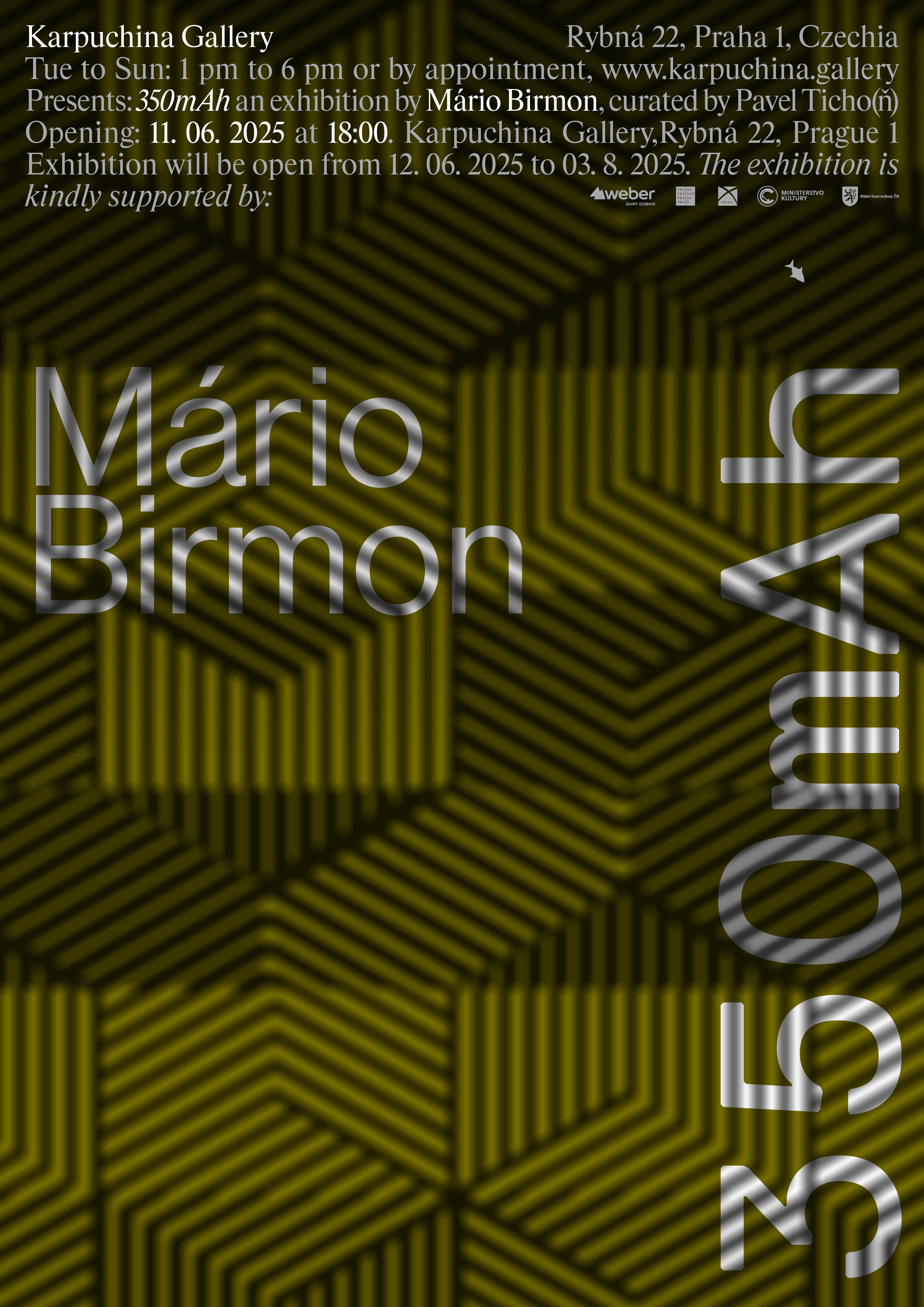
350mAh by Mário Birmon 12.6.2025 - 3.8.2025Curator: Pavel Tichoň


Text
“Lithium is to the 21st century what fire was to the Paleolithic.
But who holds the flame today?”
Mário Birmon’s exhibition 350mAh is a visual-essayistic expedition into Bolivia’s Salar de Uyuni - a geological and mythological landscape sometimes referred to as the “white mirror of the Andes.” In contrast to this romanticized image, Birmon presents a photographic reflection of a place that is not only the world’s largest salt flat but also one of its most significant lithium reserves - turning it into a geopolitical hub of the future and a laboratory of global energy systems. Lithium - a chemical element neither essential to our bodies nor our minds, yet indispensable for lighting up both smartphones and Teslas - becomes the protagonist of Birmon’s environmental topography. Through this lens, he exposes the global obsession with and acceleration of resource extraction driven by technological progress. His work reminds us that the element powering tiny earbuds and colossal data centers alike is, like many of the world’s commodities, rooted in a history of exploitation, geopolitical tension, and environmental disruption.
The conceptually cool and minimalist title 350mAh (milliampere-hour) sets the aesthetic tone of the exhibition, referencing battery capacity - a unit familiar from power banks and headphones. Yet, on a surprisingly poetic level, it also serves as a metaphor for human endurance: how much energy do we have, how much do we consume, and what are we willing to sacrifice to obtain it?
The photographs, transferred via sublimation technology onto aluminum panels, depict a landscape that is not merely an object of aesthetic admiration but a site of conflict between nature and extraction. Historically, photography has been a tool of colonialism - in the 19th century, American surveyors mapped the western landscape using silver plates, a technology that was both a scientific instrument and symbolic means of domination. Today, even though we use CMOS chips and digital sensors, the underlying principle remains unchanged: the image remains a medium of acquisition. Birmon explores this continuity - visual culture is still tied to salt chemistry and to structures of power. Lithium is a material for batteries, but it also becomes a metaphor for what gives images tension and memory.
“This work is not only about the landscape as a site of extraction, but about the complex relationship between image-making technologies and structures of power. There is a certain paradox here - documenting environmental collapse using tools that themselves originate from it,” notes the artist.
The images adopt a hexagonal grid structure that serves as a visual metaphor: evoking salt crusts, printed circuit boards, and indigenous patterns - three layers of a single reality. They reflect cultural archaeology, technical precision, and intuitive ornamentation.
A key feature of the installation is the presence of two five-meter opposing mirrors, creating an illusory infinite space. Within this optical loop, the boundary between image and viewer dissolves. Reflection becomes part of the work - not as a formal trick, but as a moral gesture: whoever gazes upon this landscape of ruin is also looking at themselves. Parallels can be drawn with the works of Dan Graham, where mirrors serve as tools for self-reflection and disrupt the illusion of the neutral observer. Similarly, Yayoi Kusama’s infinite mirror rooms materialize the inner space of consciousness. Birmon, however, employs the mirror as an ethical test: what happens when we place our own face where the artwork should be?
Birmon’s method is quiet, observational. He does not hold banners, glue himself to streets, or throw tomato soup at the classics. His environmental protest unfolds through an aesthetic of detached recording - in images that are not illustrations of the problem, but its cipher. Are we willing to forgo comfort, knowing that others pay the price for it? Do our doubts vanish when they are wrapped in the sheen of sustainability? Without the salt flats of Bolivia, our digital world might have remained a dream of engineers. But what remains of the landscape when that dream becomes infrastructure? And is the mirror a window - or a weapon?
Mário Birmon(b. 1983, Zvolen) is a Slovak photographer and visual artist based in Berlin. He graduated from the Academy of Fine Arts and Design in Bratislava under the mentorship of Vojtech Kolenčík. In his work, Birmon bridges technology, perception, and environmental themes, with a particular focus on global inequalities and hidden structures of power. He primarily works with photography, using it in both documentary and conceptual forms - often combined with data visualizations and digital structures. His projects, such as Heat 4 Speed and Garden of Eden, explore the tensions between civilizational comfort and ecological or social exploitation. Birmon’s works have been exhibited at institutions including the Slovak National Gallery in Bratislava, CHROME47 (Alte Münze) in Berlin, and the group exhibition Heuristic Algorithms at Pragovka Gallery in Prague.
– Pavel Tichoň
Documents